



Generating traffic is only half the battle. The real challenge lies in converting visitors into free trial users, demo bookings, or paying customers. Many SaaS businesses invest heavily in SEO, paid advertising, and content marketing, only to discover that their website isn’t converting visitors at the rate they expected.
This is where Conversion Rate Optimisation (CRO) comes in.
Conversion Rate Optimisation is the systematic process of improving your website and user experience to increase the percentage of visitors who complete a desired action. Whether that action is signing up for a free trial, requesting a demo, subscribing to a newsletter, or purchasing a subscription, CRO ensures you’re making the most of every visitor that reaches your website.
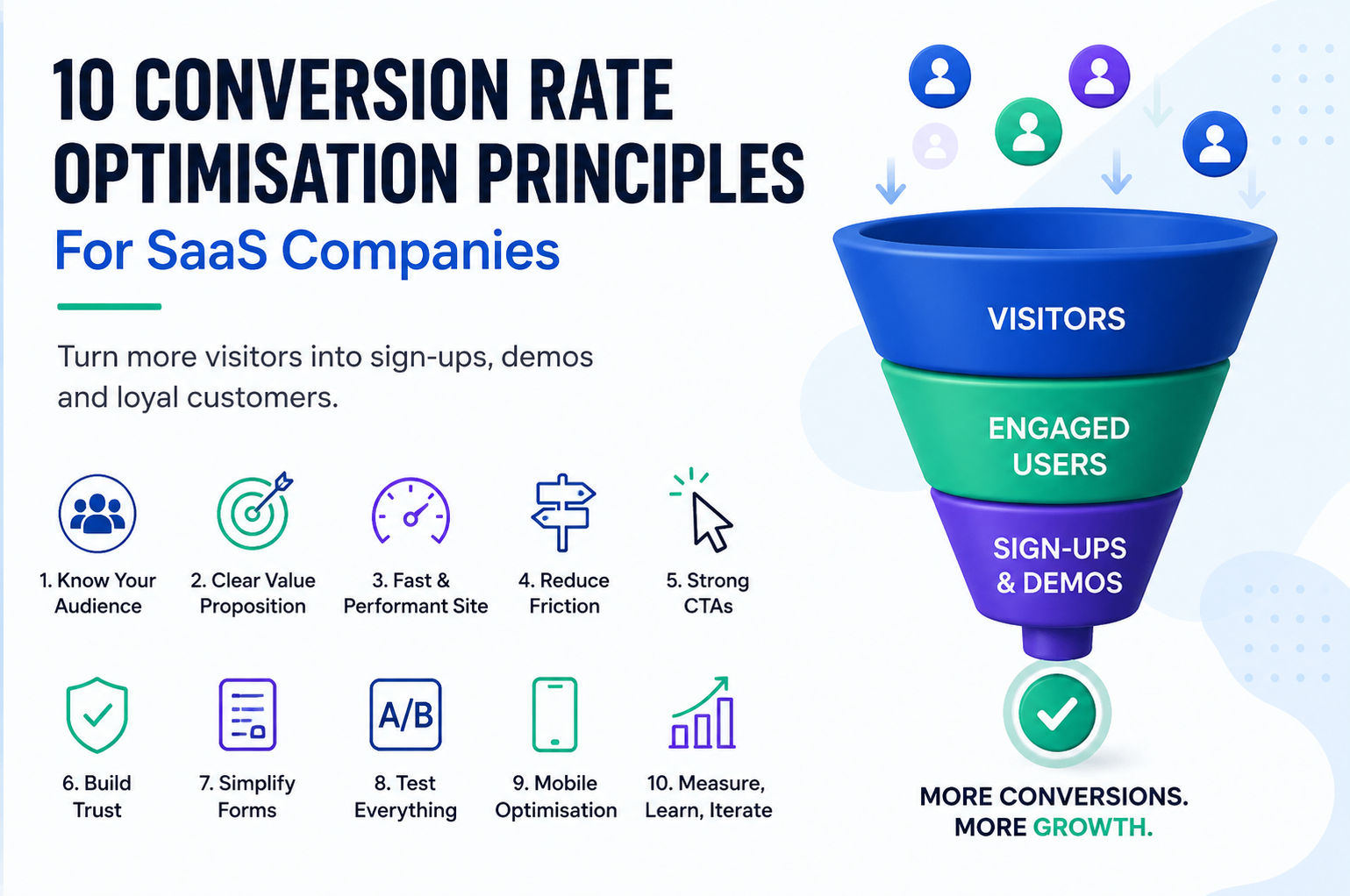
Unlike acquiring more traffic, CRO focuses on extracting greater value from your existing audience. Even small improvements in conversion rates can significantly impact revenue, customer acquisition costs, and long-term business growth.
Let’s explore the ten principles every SaaS business should follow to build a high-converting website.
1. Know Your Audience Before You Optimise
One of the biggest CRO mistakes is optimizing for assumptions rather than actual user behaviour.
Before changing headlines, redesigning landing pages, or experimenting with CTAs, understand who your users are and what they need.
Ask questions like:
- What problem are they trying to solve?
- What objections prevent them from signing up?
- What information are they looking for before making a decision?
- Which pages do they visit before converting?
Use customer interviews, heatmaps, session recordings, surveys, CRM insights, and analytics to uncover these answers.
The better you understand your audience, the easier it becomes to create experiences that encourage conversions.
2. Make Your Value Proposition Instantly Clear
Visitors decide within seconds whether your product is worth exploring.
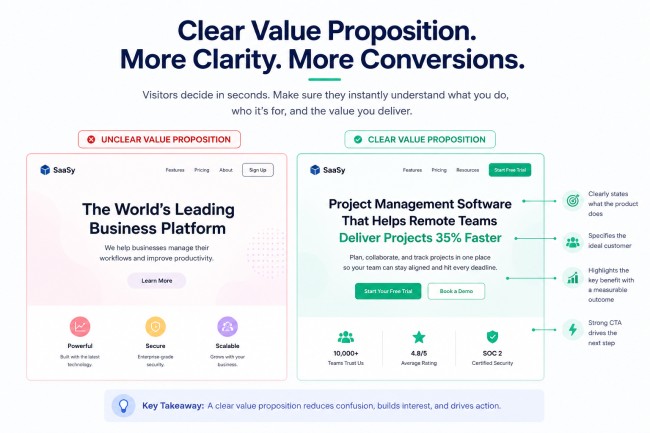
Your website homepage or landing page should immediately answer three important questions –
- What does your product do?
- Who is it for?
- Why is it better than the alternatives?
Avoid generic messaging like: “The world’s leading business platform.”
Instead, focus on clear value propositions.
For example: “Project management software that helps remote teams deliver projects 35% faster.”
Clear messaging reduces confusion and increases engagement.
3. Improve Website Speed and Performance
Even the best designed landing page won’t convert if it loads slowly.
Users want answers and solutions fast, they will not give your website a second chance if it takes 10 seconds to load. Modern SaaS buyers expect websites to respond instantly. Every additional second of delay increases bounce rates and reduces conversions.
Improve performance by:
- Compressing images
- Reducing unnecessary JavaScript
- Using caching
- Optimising fonts
- Choosing reliable hosting
- Loading critical content first
A fast website creates a smoother user experience while also improving SEO performance.
4. Reduce Friction Throughout the User Journey
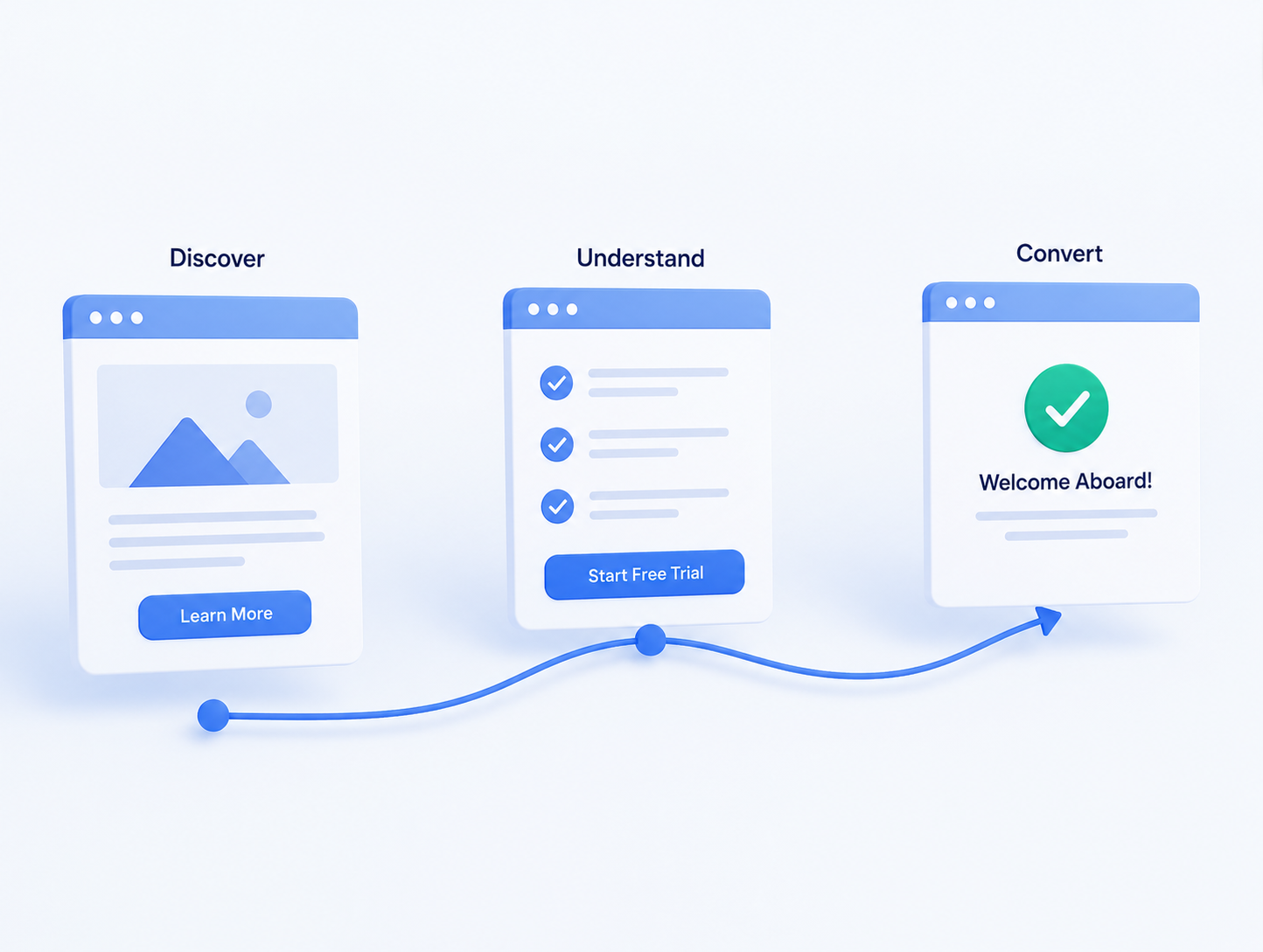
Every unnecessary step decreases the likelihood of conversion. Users want to see your product, services and offerings as soon as possible, so that they can evaluate your offerings and make a decision on whether you are the right solution they are looking for or not.
If there is unnecccesary friction throughout your website and web application, users will give up sooner than later.
Look at your website from a first time visitor’s perspective.
Common friction points include:
- Too many menu options
- Complicated pricing pages
- Long signup processes
- Confusing navigation
- Hidden CTAs
- Excessive form fields
Every click should move users closer to their goal – not force them to think about where to go next or to wonder how to find the information or service offerings they are looking for.
The simpler the journey, the higher the conversion rate.
5. Design CTAs That Encourage Action
Your Calls to Action is one of the most important elements on any website, not just SaaS businesses.
A weak CTA creates uncertainty.
Instead of using generic Calls to actions like – Learn More, Submit Click Here
Use action-oriented language such as:
- Start Your Free Trial
- Book an online Demo
- Get Started Today
- See It in Action
- Schedule Your Consultation
Make CTAs visually prominent with contrasting colours, generous spacing, and strategic placement throughout the page.
6. Build Trust Before Asking for Commitment
SaaS purchases often involve significant financial and operational decisions.Visitors need confidence before they convert or even do a signup to see what your product offers and what are the specifics.
Strengthen trust using:
- Customer testimonials
- Case studies
- Client logos
- Product reviews
- Security certifications
- Add Money-back guarantee badges at key checkout points.
- Industry awards
- Transparent pricing
Showing real customer success stories helps reduce perceived risk and increases credibility.
7. Simplify Your Forms
Every additional form field creates friction.
Ask only for information that’s essential.
For example, instead of requesting:
- Name
- Company
- Job Title
- Phone Number
- Industry
- Company Size
- Budget
- Timeline
Start with:
- Name
- Business Email
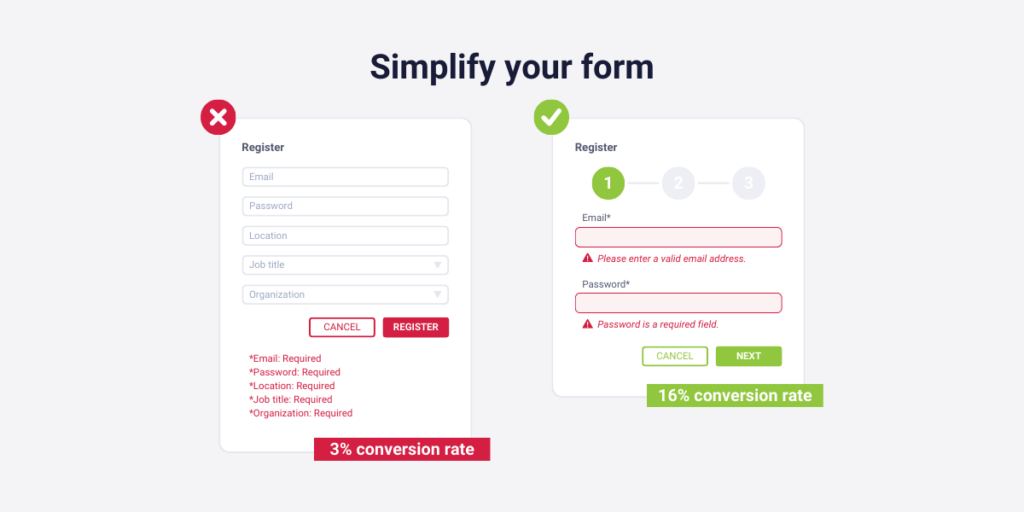
Additional information can always be collected later during onboarding or sales conversations.
Shorter forms typically convert faster and convert more frequently when compared to forms that require too much time and energy to fill.
8. Test Everything – Never Assume
Successful CRO is driven by experimentation, not opinions, assumptions or endless hypothesis.
A/B testing allows you to compare two versions of a page and determine which performs better. Testing different messaging options helps you understand which messaging is resonating with your user base. Testing two different types of forms hlps you conclude which form type users are filling out more.
Test, test, test – never assume what you have it the best. Never think that if it looks good, it must be good and doing it’s job.
No it’s not. It’s just what you think – it may not be the reality.
Elements worth testing include:
- Headlines
- CTA buttons
- Hero images
- Pricing layouts
- Testimonials
- Product screenshots
- Form length
- Colour schemes
Sometimes even small adjustments can produce meaningful improvements in conversion rates.
The key is testing one variable at a time while collecting statistically significant data. When you test, give each experiment enough time before you test the next element. A typical time frame to test elements on your website would be 2 weeks or at least 10,000 unique users.
9. Optimise for Mobile Users
Users or Decision makers increasingly research SaaS products on mobile devices before switching to desktop to complete purchases.
If your website’s mobile experience is poor, you’re losing potential customers before they even reach your sales funnel.
Ensure your website provides:
- Responsive layouts
- Fast loading speeds
- Readable typography
- Easy navigation
- Large tap targets
- Mobile friendly forms
A consistent cross device experience builds confidence and increases conversions.
10. Measure, Learn, and Continuously Improve
Conversion Rate Optimisation is never finished.
It’s a continuos job and you will never be done optimising your SaaS website for more conversions. Customer expectations evolve, competitors improve, and buying behaviour changes over time.
Track key metrics such as:
- Conversion Rate
- Bounce Rate
- Demo Bookings
- Trial Sign-ups
- Customer Acquisition Cost (CAC)
- Average Session Duration
- Exit Pages
- Revenue Per Visitor
Use analytics to identify opportunities, test improvements, and repeat the process continuously.
Conversion Rate Optimisation – Do’s and Dont’s
Do's Understand your users before making optimisation decisions. Create a clear and compelling value proposition. Reduce friction throughout the customer journey. Test landing pages and CTAs regularly. Use analytics and customer feedback to guide improvements. Don'ts Assume what users want without validating with data. Overcomplicate forms or signup processes. Hide important calls-to-action. Ignore website speed and performance. Stop testing after one successful experiment.
The highest converting SaaS websites aren’t built overnight – they’re refined through ongoing optimisation.
Driving more traffic isn’t always the fastest path to growth. For SaaS companies, improving the experience of existing visitors often delivers higher returns than simply increasing marketing spend.
By understanding your audience, simplifying the user journey, building trust, testing consistently, and making decisions based on data, you can create a website that converts more visitors into loyal customers.
Conversion Rate Optimisation isn’t about guesswork or isolated design changes. It’s a long-term strategy focused on continuously improving every interaction users have with your brand.
The companies that embrace continuous optimisation consistently outperform those that treat CRO as a one time project or as a seasonal experiment alone.
